What is PT-141 (Bremelanotide)?
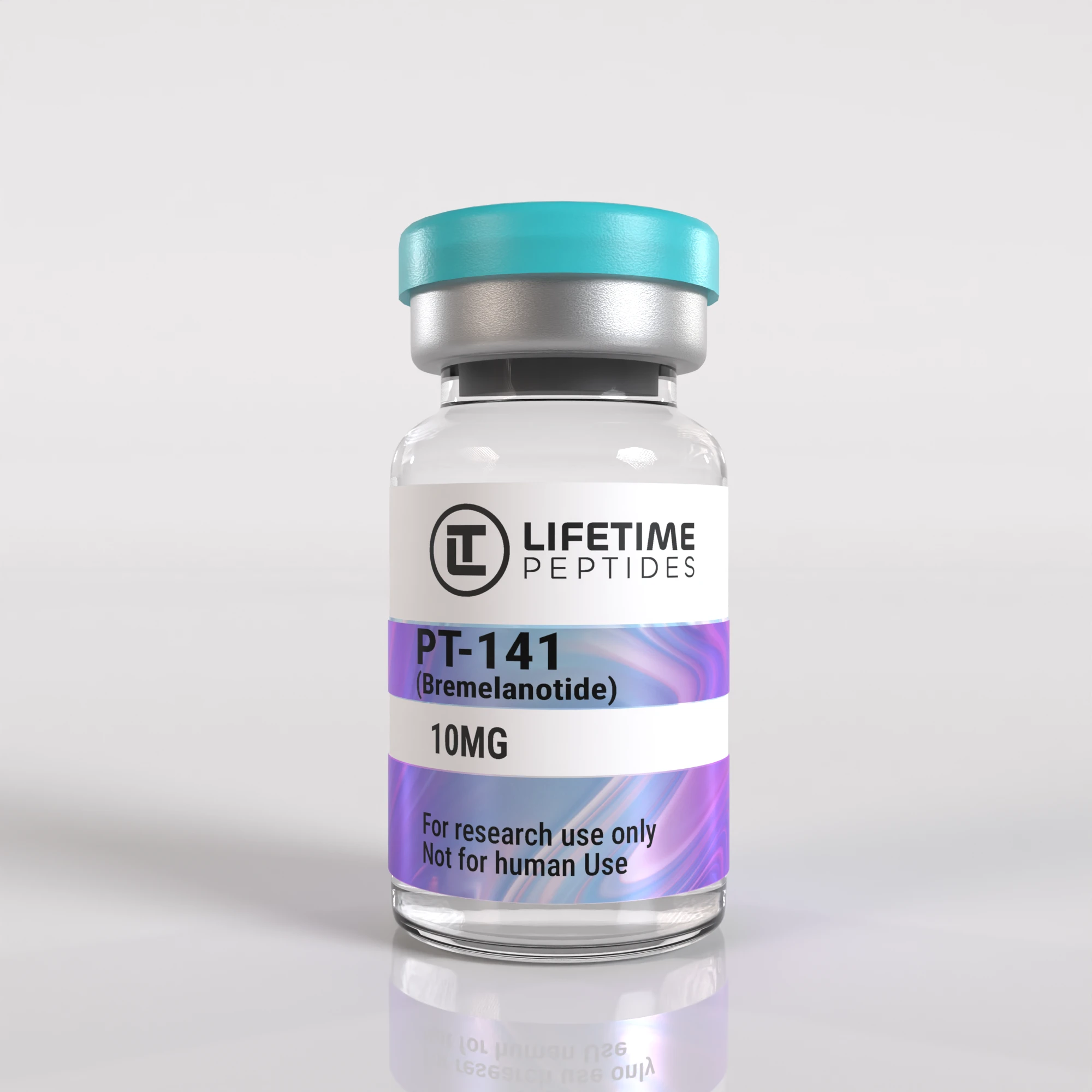
PT-141, also known as Bremelanotide,
is a synthetic peptide developed from the melanocortin analog Melanotan II.
Unlike PDE5 inhibitors (such as sildenafil), which act on the vascular system,
PT-141 works directly on the central nervous system by stimulating melanocortin receptors (MC3R and MC4R).
Research has focused on PT-141’s potential to enhance sexual arousal and function in both male and female subjects,
making it unique among sexual health peptides.
PT-141 Structure
| Peptide Name |
PT-141 |
| Synonyms |
Bremelanotide, Melanotan II derivative |
| Sequence |
Ac-Nle-Asp-His-D-Phe-Arg-Trp-Lys-NH2 |
| Molecular Formula |
C50H68N14O10 |
| Molecular Weight |
1025.2 g/mol |
PT-141 Research
1. Sexual Function and Arousal
PT-141 has been studied as a treatment for hypoactive sexual desire disorder (HSDD) in women
and erectile dysfunction in men. Research shows that it acts on the brain’s melanocortin system
to increase sexual desire and arousal rather than simply improving blood flow.
2. Comparison to PDE5 Inhibitors
Unlike drugs such as sildenafil (Viagra), PT-141 does not rely on vascular dilation.
Instead, it targets central nervous system pathways, which may benefit individuals who do not respond to PDE5 inhibitors.
3. Clinical Development
PT-141 has undergone clinical trials and received FDA approval as Vyleesi
for the treatment of HSDD in premenopausal women, highlighting its significance in sexual health research.
Future PT-141 Research
Future research may explore PT-141’s broader applications in sexual dysfunction,
including in men with ED unresponsive to PDE5 inhibitors, and potential roles in psychological arousal disorders.
Additional investigations may examine long-term safety, dosing optimization, and its neuroendocrine effects.
PT-141 Resources
- Diamond LE, et al. – “Bremelanotide for female sexual dysfunction: results of phase II clinical trials.” J Sex Med, 2006.
- FDA Approval: Vyleesi (Bremelanotide) for HSDD in women.
- Research on melanocortin receptor agonists and sexual function regulation.





Reviews
There are no reviews yet.